Fiction

Hey, you. Yes, you!

Hey.

I’m sending you an image.   It will reach you somehow.

You’ve been unresponsive since we got you back from the enemy, but the doctors say your mind is active in a  dream prison they made for you.  A life so real you can’t escape it.    Reasons to stay there.  

I don’t know what dream it is but my words have to reach you. 

Maybe you’ll hear them, or read them in a book. 

Maybe on a screen.

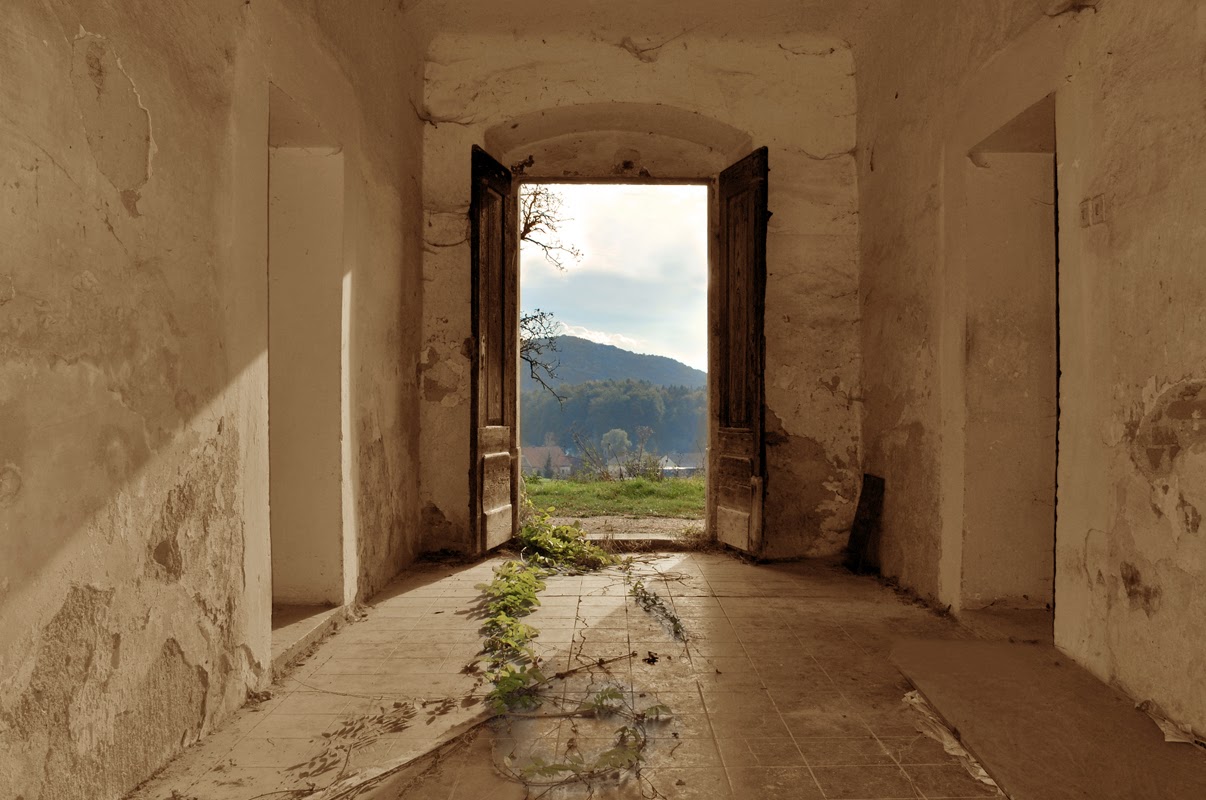
You have to walk through the door to wake up.  The door in the image.

Please.  Do it now.

Fiction

Wooden Heart

The grove of trees was secluded, and it was dark.  It was ancient and largely unknown.  And it was waiting.    The eldest of the trees held court there, squatting like a bloated tyrant with a tanglewood crown and grasping miser’s fingers raking the earth around its corpulent trunk.   Healthy things did not grow there, wholesome plants did not flourish.   Birds did not roost in the trees of that grove, not the wise old birds anyway.  Ravens shunned it.   Foolish fledgeling songbirds who fluttered into the tyrant’s little realm did not flutter out again.   Insects and crawling things flourished and dug and bred greedily in the stinking moisture of the hollows of that grove.

An approaching light, flimsy and weak.   Two men picked their way through the night, a lantern held aloft by the older of the two.

“It is much further?” said the younger, a strong young man in his twenties, broad shouldered beneath his roughspun jacket.   His voice carried the barely masked complaint of someone who had been out much later than he expected to have been out, and who had travelled much further than he had wanted to.

“No,” said the older man.   He picked his way between two wiry sentinel trees and carefully stepped down and down and down the grove’s steep sides.   “We’re here Antonio.   Watch your footing.”

Antonio, the younger man peered down into the place that his neighbour had brought him to and he grimaced.  The air was foul.

“This is not a healthy place,” he said quietly.

“What is a healthy place?” said the older man hanging the lantern from a jutting branch.   “Where in all of Tuscany is healthy?  Is safe?”

Antonio recognised the familiar bitterness in his neighbour’s voice.   “My friend, the cholera has passed us by.   You cannot keep blaming…”
“God mocks us,” said the older man, pacing slowly to the edge of the clearing, feeling the earth suck hungrily at his boots.   “He despises us.   I despise him in my turn.”
Antonio crossed himself.

“He took my wife from me ten winters past,” said the older man, “and left only my boy to remember her by.   All the love I had for her I poured into him.   My hopes.   Everything.   And I gave thanks to the Almighty for him.   And then the Almighty showed his undying love again.”   He spat copiously on the earth.    “The cholera hung over our town like an unseen angel seeking who he might devour.   My boy…”

“Please,”

“My boy!” the old man said angrily, turning and pointing a finger at the younger man.   “God showed his contempt for our lives, our hopes, our efforts!   Should I bear it in smiling silence, as a woman bears the fists of the drunkard who beats her?”   He looked up at the distant sky and bit his thumbnail.    
Antonio did not answer at once.   He would let his neighbour’s anger rage and burn itself out, and what good would argument do for him now, here in this place?   This place cared nothing for words.

“My grandmother’s mother came here,” said the old man more quietly now.   “She was born in Palermo, but she fled north with nothing but the clothes on her back and a bundle of sticks.    The priests called her strega, a witch.   And the Inquisition was still a power in those days.  Strega!”    He wiped his chin, clearing it of the spittle that had flown there when he had raged.

“A slander,” said Antonio

“The truth,” said the old man with no shame in the words, but rather pride.   “She found this place, this very place, and she added her bundle of sticks to the old wood that grew here.   Sticks from the woodlands she’d danced in as a girl.”
A gust blew the lantern a little and the shadows moved and encircled the two men.    Antonio shivered and looked around, the older man closed his eyes as though embraced.

“There are trees as old as Eden,” the old man said, his voice soft, “who drank up the water from the ground when Adam and Lilith coupled in the midnight heat.   Who supped on the tears of Eve who wept when the Almighty’s curse fell upon her,”

“We should go home,”

“Trees who sank beneath the deluge and refused to die,” the old man said, his voice stronger now, “who knew their enemy for what He was and held on fiercely to life and waited for their moment.”

Antonio came slowly toward his friend and took hold of him by the shoulders.

“You’re distressed,” he said in a voice that shook with fear for his friend’s wits, “but you must stop this talk.   It is sacrilege.  Blasphemy.”

The old man’s eyes looked into Antonio’s and did not know him.

“Trees that gave their wood gladly for the crosses on the sullen brow of stone beyond Jerusalem.   Who rejoiced to drink the blood that-”

“Enough!” Antonio shook the older man roughly, hoping to break him out of this feverish rage that twisted truth and the world around an old man’s grief.

“He is with us,” said the old man in a triumphant voice, and above them old limbs, ancient limbs moved and creaked in the wind and something cracked and roared and fell.   Antonio looked up too late and raised his hands too late and felt a thunderbolt of dry and eager weight strike him on the head.

When pain woke him it drove away dreams of whispering voices and replaced those dreams with searing hot agony from temple to jaw.   He was lying on the ground in the mud beneath that ancient tyrant tree and he was tangled there in down-drooping branches and thorny vines that clustered around its roots.   Beneath his wounded head there was mud and bloodied water and his heart was a pounding drum that shook his whole body.

The old man was crouching nearby, hunched over the fallen branch that had struck Antonio.  It was bulbous and fibrous, as thick around as a man’s thigh, and the old man was sawing off the smaller shoots and tendrils that writhed and bled grey sap as they fell to the ground.

“Help me,” Antonio said, his voice a phlegmy gurgle.

“See what he has given me,” the old man said, not looking up from his work.   “He is generous.   He that my grandmother’s mother knew by name, see what he has given me.”   He put away the knife into his belt and grunted as he hefted up the hewn log of ancient gloating wood.   “He will restore to me what was stolen.”
“Help me up, help me get free of these…”  He was going to say ‘hands’ but that would have been madness, surely.  “Of this tree.   My head is split, help me to stand.”
The old man shook his head and tucked the log beneath one arm, reaching up to take the lantern from the branch.

“You remain,” he told Antonio, “You remain.   A gift demands a gift, that is the old way.”  He turned away and the night closed around the trapped young man like water rising over the ground.    Crickets and beetles emboldened by the dwindling light crept, then ran, then danced over the captive.
“Don’t leave me here!” he called.  He struggled, thrashing his limbs, but the limbs of this grove’s old master were stronger still and held him fast.   The lantern light was almost gone now, the old man out of sight.  “Don’t leave me!  Geppetto!”    The darkness engulfed Antonio completely and the wind through the branches above him lamented him in mocking tones, and the crawling things in his nostrils and mouth and ears whispered as they feasted and told him of the mighty deeds that the carpenter’s son would bring to pass.

**

My novel A Step Beyond Context is currently on sale at Amazon (until June 24th) – if a dimension-travelling heroine facing down Regency intrigue and cyberpunk mayhem appeals then there has never been a better time to go along for the ride.

Fiction

Beautiful Stranger

When I first became immortal I assumed it would be like being part of an exclusive club of wise and mysterious beings, roaming the earth like gods and angels.  It really isn’t.   There aren’t many of us but we keep bumping into each other.   The world becomes a dull party.  You know their jokes, stories, habits and hang ups.   One minute you’re sitting on a beach watching the sun set and the next some bastard’s bitching about some merchant from Thebes who stiffed him over an amphora of bad wine.    Most of us become solitary.  All of us become bad company.

Not you

Hah.  Maybe.    I’ve been alone too long and sometimes I need to make contact.   Not with another immortal though.    Tedious bunch, like I said.  And the ones that aren’t tedious are too damned dangerous.   I warned you about those didn’t I?

Scared me silly.   I’ve been looking out for Them ever since.

They’re too good at hiding.  I’m putting you at risk by talking to you, I should go.

Please don’t.  I want to learn more about you.  Not just the immortality thing, but you.  You as a person.

Too dangerous.   They are always watching, and they hate the idea of one of us opening up too much to a mortal, exposing our secrets.   But I have to.   The solitude crushes me sometimes.   I just want to watch the sun rise with someone by my side who understands.  Just once.    Idiotic really.  Sentimental.   And dangerous for you.  I can’t believe I’ve been so reckless, I’m sorry.  I’ll go now.

Please!  I want you to stay.  I want to watch the sun rise with you.   Want to know you better.  You don’t have to be lonely.

Alright.  If you want.  There’s a high hill above the bay, glorious view to the east.  Know it?

I do!

Meet me there in two hours.    Be careful They don’t follow you.

I’ll be careful.  I love you.

I love you.   Delete your chat logs.

Fiction

NSFW

It was a hot day, and the office seemed hotter than the world outside.  Despite the air conditioning she was perspiring, feeling lazy and sticky and just a little bit horny.

Looking around herself, seeing that none of her co-workers were looking at her she slipped her cellphone from her purse and used her thumb to deftly caress words into a new text message for her lover

Text me something NSFW
She smiled a private smile as she sent it, and imagined how he’d react.    Seconds later her phone whispered to her that a new message had arrived.  Reaching down and holding the phone below desk level, flat against the so-proper dark blue skirt, she opened the message.
What’s NSFW?
She tsked in frustration.   Sometimes she half believed that he was a refugee from the Victorian era as he often joked.    Her thumb moved again on the slick screen, teasing out a new message letter by letter.
Not Safe For Work.   You know… something provocative.
She sent the message.   The word provocative pleased her… it was long and complex, a pleasantly rounded couple of syllables followed by a sharp ending, like a caress that became a demanding kiss.    She looked at the screen waiting for his response, imagining his mind working and his passions rising.  She wondered if it was as hot where he was as it was here.
An email arrived from a client and she put the phone down on her desk and started typing a reply to that mundane enquiry about warranty violations.  Halfway through the email, her phone sighed once more and she saw his name appear on a new message notification.  She held her breath and finished the email quickly, sending it as quickly as she could.

Then she picked up the phone and opened the message.

Not Safe for Work?  Okay, here we go:   The capitalist system is inherently stifling of the human spirit – you are paid far less than you are worth and are wasting your endless creativity in the service of dullards, performing repetitive and menial tasks that consume your time and your potential.   Your boss is a manipulative shrew, and her boss lusts for money and power at the expense of everyone around him.  Walk out of there today, and take as many of your co-workers with you.   An end to wage slavery! 

How’s that?

She read it through twice, sighed, then sent her reply.
Perfect.  Not what I was hoping for, but perfect.

Before she could send it she heard a tapping on the glass wall that incarcerated her and her co-workers.  She looked up, as did others, and she saw him, phone in hand and ridiculously elegant in a dark three piece suit.  He had his habitual wicked half-smile on his face.


She smiled back, stood, put on her shoes, picked up her purse and walked across the room to the door, ignoring everybody else in the room.  Forever.
**
Finn Cullen’s first novel “A Step Beyond Context” is now available on Amazon in Kindle and Paperback editions – a mystery pursued across many worlds and a heroine who won’t give up no matter where the truth leads her.
Fiction

The Stone and the Seven

Cannot sleep my lady?  Then draw close to the candle and listen.

I will tell you a tale of the old old days there were not in fact so long ago as you would hope.

The King in those days had two sons.   The eldest son, the heir was a foul creature, handsome enough to look upon but nobody could long bear his presence without wanting to flee him or strike him.   The King indulged his eldest son and the people suffered for it, but not so much that they would rise up and turn horror into anger.

In those days a traveller came through the wood, astray in the dark heart of it, lost and cold.  Each path mocked him with its turns and every way he took brought him back across his own earlier path.   If he called on the Virgin for guidance she did not hear him or choose to answer.

The denizens of that house were several and they were foul welcoming him with mocking eagerness, complimenting the length of his limbs and the strength of his frame and the beauty of his features.   They themselves were short and twisted things, pale and half formed with faces that called to mind the slack hanging faces of the dead.   They dragged him into their hovel and sat him at their table.   They all assured him that his presence honoured their dreadful cottage, all except for one more malformed than the rest who lacked the power of speech and simply rested his bulbous head on the table and damped the wood with his drooling.

He ate their rancid meat and drank their fusty water as hospitality demanded and he felt his stomach rebel but his manners kept the foul mess down.

And then they offered him a treat fit for a prince.  The offer was  made with leering smiles and wicked hints of tone and gesture.    Behind the cottage there was a path of pale cobbles half buried in the mud, white and brittle they looked and his feet slipped on them as the creatures swarmed him toward their goal, a clearing in the woods like a bald patch on a diseased scalp.   There was a slab there, a stone altar, rough and cruel and well used.   The old worshippers had altars like this before their gods were purged with fire and salt.    There on the altar was a maiden, still and pale and as the stories would have you be assured, fair beyond measure.

The stranger demanded to know what was meant by it, how these misshapen brutes should come to have the company of a woman so unmarred.   The creatures smiled, or scowled or drooled according to their nature and the leader of them explained in sly words how they were commissioned to the work by a great man, and that the lady was a pleasure fit for a prince.

The prince, they explained, would not visit until later and so if the gentleman visitor wished he could avail himself of the lady.  A modest donation to their coffers would suffice.

The stranger drew his sword and butchered the monsters.   Their pale flesh parted beneath his steel, their limbs fell jointed to the ground.   They did not resist even so much as a child might and died in confusion that their gift should be so scorned.   When they fell dead the stranger tried to rouse the lady and found that no power short of the final trump on the day of resurrection could do so.  She was cold and still and would never rise again from that brooding stone.  What surgeon’s art had preserved her in so fair a condition he did not dare imagine.

He did not hear the prince, the heir approach.  The young man was grievously wounded as the prince slashed his face back and forth with his dagger decrying him as a slayer of his loyal and secret servants, and demanding of him where he would find his cold pale brides now.

And that is the tale I have told.  I do not know if you smile or frown at it, for my brother’s blade took my eyes that night so long ago, when our father still lived.

In the morning I will bring you your breakfast to fit you for your journey.

Blow out the candle when you are ready my lady.

Sleep deeply.

*

Finn Cullen’s first novel “A Step Beyond Context” is available now at Amazon in Kindle and Paperback versions.

Fiction

Abandoned Beauty

“He’s on his way, I’ve seen him through the eyes of owls.  Young and full of vigour,” Her voice was self-satisfied, with just a hint of lewd appreciation.
“So romantic,” came the reply in gentle delicate tones of wistful contentment
“Romance be damned,” the third voice was a menacing rumble, “it’s the story that draws him.  Always the story.”
The three of them waited in an upper room, looking out of the window into the wooded valley below.   The house was glorious once, but that was before it had been abandoned to the elements and to time, before moss and vines grew over its surface and the burrowing creatures dug into its rocky foundations, before the rain and wind of countless years wore away the paint and etched age into the face of the building.   
The three of them wore the shapes, more or less, of women.
“We should try to stop him of course,” said the first of them, “Should I…?”
“No,” sighed the second, “let me.  Poor boy.”   She relaxed out of her vanishing body and the valley forest pulsed in response.
“She’ll botch it,” growled the third.       They watched as the canopy of trees quivered far below and a few moments later the one who had vanished returned.   She was ragged and glaring now, her green clothing tattered and torn.
“Clever boy,” she said, and she’d lost the wistfulness,  “My vines and stinging plants engulfed him.  He sprayed me with chemicals and withered me.”  She spat on the floor.  It steamed.
“My wolves will end him,” said the first of them.  Her eyes gleamed orange and she was gone.   Below there was howling and shouting and chasing and…
She was back suddenly, clutching herself and leaking blood.
“Revolvers,” she growled, “and he’s a bloody good shot.”
“Useless,” boomed the third of them and the sky darkened as she vanished.   “Leave.  Him.  To.  Me.”    The last four words were thunder crashes, and lightning stabbed the valley shattering trees and stone where they struck.
The other two looked at each other and waited.
“He’s good,” said the one in tattered green.
“He’s the one,” said the wolf-eyed woman.
Suddenly the third of them was back, pale and furious.
“He’s a pain in the backside,” she said, “And he’s tough.  Made it to the steps.”
They all peered out of the window and looked down.  Far below a young hero staggered up the long flight of stairs leading to the house.   He was injured and soaked and a little scorched, but undaunted.
They sighed and moved further in, resting on a balcony overlooking the grand hall below.  In the centre of the hall was a bed and on the bed a maiden lay, pale and golden haired and untouched by time.
The young man thrust open the mossy doors and staggered into the room.   He paused as he took in the beauty of the maiden sleeping in the mansion lost to time, but he only paused for a second.   And then, his strength renewed he strode forward and bent over her to kiss her flawless skin.
“They always get the story wrong,” the first grumbled as the maiden’s eyes flickered open.
“Such a shame,” agreed the second.   The maiden wrapped her arms around his shoulders and opened her mouth wide, revealing twin rows of pearl white fangs.  The young man screamed as she bit down.
“The sacrifice of the heroic king,” said the third, nodding, “has to be the strongest, the cleverest, the finest.   And they’re the only ones that make it through, who make it past the flora, and the fauna and my merry weather.”    
In the chamber below the maiden sat up and stretched, her gown soaked scarlet, her lips dripping gore.     She waved at the three faerie who had guarded her, and they waved back grinning.
Job done.

Fiction

Avalon

 
My grandfather once told me that he’d spent his whole life in summer.   I was a child then and I didn’t understand, but I believed him.  There was sunshine in him, always warmth, and he took delight in everything.  Being around him was like an easy purposeless walk on an August evening through the wooded lanes around his house.   I’d walked those lanes and knew each turn, each fence, each sunbeam.    Those lanes had seen a thousand thousand of me — the cowboy, the knight, the pirate, the explorer, latterly the thwarted romantic hero.   We’d walked those lanes for years and countless summer stories had been told in the dappled light.
My summer was coming to an end.   As September slouched over the threshold I’d leave for university and take up a course that was practical and appropriate, which would be the gateway into growth and progression and forward planning and productivity and purpose and perhaps, someday, a comfortable retirement in which I could take long and easy walks to nowhere and everywhere and then, ultimately, to nowhere again.

Standing in my grandfather’s garden, between the two apple trees exactly the same age as me, I heard absent echoes of running feet and excited voices overlaying the silence.   What did they have to be excited about?  Hadn’t they seen the autumn clouds over the nearby woodland?   Hadn’t they known about the rain that would turn the green grass to mud and ruin?

No.  They hadn’t.  It had always been summer here, even when the snow piled up so deep and white and crisp that it remade the world.  Always summer, and no clouds and no rain could drive away an old man’s smile.

But September was coming. Summer would be a memory, as glorious, unreal and intangible as a rainbow.

I stepped away from the two apple trees, exactly the same age as me, and back toward the slowly emptying house, and the expressionless faces and low tones of my well dressed relatives

***

Finn Cullen’s first novel A Step Beyond Context, a family drama and mystery spread over many worlds is now available on Amazon – Click HERE for more details.

Fiction

Little Rosie – Chapter One

(Click here for the PROLOGUE)


I had been fortunate enough, in the two years after my father was murdered, to avoid the attentions of White Kenneth and his runners.   Many of the denizens of St Giles did not.   He preyed upon the isolated, the lonely and the helpless.  And the young.  Especially the young.   Do not think, sir, that one such as White Kenneth would have been stirred to sympathy with the plight of an eight year old orphan girl who found herself without protectors.   He would not.   He would have licked those pale lips of his and given the order for a couple of bag-men to go a-hunting.  And he would have mentally estimated his profits, and imagined spending them even before those bag-men returned with their quarry.

But I was sharp witted and sly, and well aware of the dangers.   I kept well clear of White Kenneth and his dreadful crew and although my path and his did cross, rather dramatically, that was not until much much later and ended rather… messily I’m afraid to say.   I pride myself of always having been a neat worker, but alas it is not always possible to do ones best work at all times.

Do pour me another spot of sherry would you?   All this talking is dry work.    Most kind of you.   So.   After my father was taken from me I fell into the company of dear Jack Merryweather.    He was fifteen or sixteen at the time and quite the elder brother to me, having been one of my father’s companions on various little jobs.    Jack was quite a card, always with a smile and a quip, and with what my father called a fool’s face… he could always look entirely innocent.   Jack Merryweather was the sort of scamp that if you entered a room and saw him with his hand in your strongbox, he could tell you that he was adding a few coins of his own as a Michaelmas gift and you’d find yourself thanking him for his kindness and sending him on his way with a handshake.  After which if you were wise you’d count the rings on your fingers.   Dear Jack, he was such a kind young man too.    He took me in and gave me a safe place to sleep and we worked together on… our business… very well.  I must have been about eight years old at the time but already quite adept at the basics of the trade; shinnying up drainpipes and through tiny windows for instance; or turning a tear streaked face of abject misery to some well appointed old fellow and telling him about my broken dolly while Jack emptied the contents of his pockets all unobserved.   Oh but you know this sort of thing I’m sure, quite commonplace.   We made enough to live on, and just a little over for occasional comforts.   It was a good life I suppose, though it never could have lasted as it was.    We were good apprentices but would never have progressed much past that.

Poor Jack.  He never got the chance.

I suppose I was ten years old when it happened.  I remember the day as though it was yesterday, a dreadfully cold day in October 1850 and I was sitting inside Charlie’s Chops just off Cowper Alley.   Oh I’m quite sure it isn’t there anymore.   Most of the old places have gone now, and good riddance to them I suppose.   It was a little hole in the wall sort of place, more like the front rooms of a house than any real business, but old Charlie Renton made his money by selling bad food and bad gin to bad people.   Both the food and the gin were cheap as hope though so nobody minded the badness.   And it was always warm.   I got on well with Charlie because my father had got on well with Charlie so he always saved me a place by the chimney where it was warm and he’d always sell me a bowl of whatever was cooking over the fire at his cheapest rate.

What did you say?  Give me it for nothing?  Oh goodness, what an innocent you are, sir.   This was the Rookery of St Giles and Cripplegate.   For nothing indeed!   Offer any of the inhabitants of that hellhole something for nothing and they would run for the nearest bolthole in fear of their lives.   Charlie Renton sold me his dreadful stew cheap, and that was as kind as kind got in those days.

I recall I was prodding at that day’s bowl of vaguely brown, vaguely lumpy stew with a wooden spoon, and sitting perched in the brick lined alcove next to the chimney. 

“Bean stew,” Charlie said, seeing my curiousity.

“I don’t care what it’s been, Charlie,” I said, “What is it now?”

He raised a fist to me then, and we grinned at each other.  It was an old joke even then I suppose, and I’d copied it from my father.  Charlie always played along with the old banter and it was one of the reasons people liked the man so much.    They said that he’d once been a sailor in the Royal Navy but he’d given that all up after he’d lost an eye and an ear and a great slice of his face to an exploding cannon shell, so he wasn’t comfortable to look at but he always had a joke and a friendly welcome.  And cheap food and drink of course.

When the door opened it let in the cold air, and colder than you’d expect.   I looked up from my food to see who had entered and quickly looked away again.    If you think I sound fanciful, young man, then I assure you this is God’s honest truth.   In that quick glance I knew, I just somehow knew, that the man who had entered Charlie’s Chops was evil through and through.  Through and through sir.    Oh there were bad men aplenty in St Giles in those days, aye and further afield, but I had never seen one before that struck me so instantly as foul and dangerous and utterly utterly… well, forgive the repetition… evil as this man did.    He was not tall, but he was broad shouldered and as solid looking as a stone wall, with ugly flat features and skin that was pale but mottled with broken veins and discolored dark patches on his neck and forehead.   But it was his eyes, young man, his eyes that had made me look away from him so quickly.    They were cold and dry and completely without humanity.   They reminded me at once of the eyes of a dead man, sir, and I do not revise that opinion even to this day.

The other patrons obviously felt much the same as I did about this newcomer.   All conversations stopped at the instant that he stepped through the door, and all eyes were kept steadfastly away from him.   I looked at him sly-wise, my head down but peering through my lashes and wishing I’d already eaten my stew, which I had paid a farthing for, so I would not regret running out the back way if I had to.    The monstrous intruder smiled a knife-wound of a smile and said in a rough dry voice.

“Jack Merryweather.   Any friends of his here?”

Jack!   My stomach turned over at the thought that this ogre even knew Jack’s name, for in our trade and in our little world, to be known of was a sign of danger and upset, and no mistake at all about that.  And by someone of this type?  Well it was plain he was not looking for Jack to award him a wooden medal for good service to the parish.   I held my breath and did not dare move.   Those dreadful dead eyes of his looked over us all slowly.

“No friends of his anywhere it seems,” he said, and then he laughed such a laugh as I hoped never to hear again.   “Well if any of his friends pass this way, tell them Mister Honeyman passes on his condolences.  Such a sad end.”

He raised his finger to the brim of the battered hat he wore, looked slowly over us all again and then his smile just stopped and his face went slack and empty and then he turned around and walked out of the door, not even troubling to shut it.

“Sounds like Merryweather’s copped it,” said old Ikey Cleaver, “or’s about to.    I’ll go round his gaff and see that all’s well, or how bad it’s bad.”   He rose on creaky legs from the table.

“That’s a green trick,” said I, still sick to my stomach at the thought of such a monster on dear Jack’s trail, “It’s a pound to a penny that…”  I couldn’t think of a word to suit the man who had just been and gone, but everyone knew who I meant by the look I gave toward the door, “is watching to see who runs to find Jackie and will lead him right to him.”

I saw the crafty look that passed between the Monk brothers at those words.   A right pair of snakes those boys were, crafty and cruel but with no real skill to turn their ambitions into action.   I could read that look, sir, better than a parson could read a prayerbook.    They were wondering if Honeyman would pay on the nail for news of Jack Merryweather.

“Here,” said Charlie Renton taking my arm and whispering confidential like, “that’s sense you’re talking.   Get you out the kitchen window and go warn Jackie boy.   Fast and unseen, that’s the way.”

“That’s the way,” said I, sounding braver than I felt.   If I  could get to Jack’s and my little hideout before that foul Honeyman found out where he was, whether from  the Monk brothers or some other Captain Comegrass who’d sell a man’s life for a handful of coins, then all might yet be well.

“I’ve paid for that stew!” I reminded Charlie Renton as I slipped through the kitchen door.

“Business is business,” said old Charlie scraping the bowl’s contents back into the big pan.

Learn more