Fiction

Wooden Heart

The grove of trees was secluded, and it was dark.  It was ancient and largely unknown.  And it was waiting.    The eldest of the trees held court there, squatting like a bloated tyrant with a tanglewood crown and grasping miser’s fingers raking the earth around its corpulent trunk.   Healthy things did not grow there, wholesome plants did not flourish.   Birds did not roost in the trees of that grove, not the wise old birds anyway.  Ravens shunned it.   Foolish fledgeling songbirds who fluttered into the tyrant’s little realm did not flutter out again.   Insects and crawling things flourished and dug and bred greedily in the stinking moisture of the hollows of that grove.

An approaching light, flimsy and weak.   Two men picked their way through the night, a lantern held aloft by the older of the two.

“It is much further?” said the younger, a strong young man in his twenties, broad shouldered beneath his roughspun jacket.   His voice carried the barely masked complaint of someone who had been out much later than he expected to have been out, and who had travelled much further than he had wanted to.

“No,” said the older man.   He picked his way between two wiry sentinel trees and carefully stepped down and down and down the grove’s steep sides.   “We’re here Antonio.   Watch your footing.”

Antonio, the younger man peered down into the place that his neighbour had brought him to and he grimaced.  The air was foul.

“This is not a healthy place,” he said quietly.

“What is a healthy place?” said the older man hanging the lantern from a jutting branch.   “Where in all of Tuscany is healthy?  Is safe?”

Antonio recognised the familiar bitterness in his neighbour’s voice.   “My friend, the cholera has passed us by.   You cannot keep blaming…”
“God mocks us,” said the older man, pacing slowly to the edge of the clearing, feeling the earth suck hungrily at his boots.   “He despises us.   I despise him in my turn.”
Antonio crossed himself.

“He took my wife from me ten winters past,” said the older man, “and left only my boy to remember her by.   All the love I had for her I poured into him.   My hopes.   Everything.   And I gave thanks to the Almighty for him.   And then the Almighty showed his undying love again.”   He spat copiously on the earth.    “The cholera hung over our town like an unseen angel seeking who he might devour.   My boy…”

“Please,”

“My boy!” the old man said angrily, turning and pointing a finger at the younger man.   “God showed his contempt for our lives, our hopes, our efforts!   Should I bear it in smiling silence, as a woman bears the fists of the drunkard who beats her?”   He looked up at the distant sky and bit his thumbnail.    
Antonio did not answer at once.   He would let his neighbour’s anger rage and burn itself out, and what good would argument do for him now, here in this place?   This place cared nothing for words.

“My grandmother’s mother came here,” said the old man more quietly now.   “She was born in Palermo, but she fled north with nothing but the clothes on her back and a bundle of sticks.    The priests called her strega, a witch.   And the Inquisition was still a power in those days.  Strega!”    He wiped his chin, clearing it of the spittle that had flown there when he had raged.

“A slander,” said Antonio

“The truth,” said the old man with no shame in the words, but rather pride.   “She found this place, this very place, and she added her bundle of sticks to the old wood that grew here.   Sticks from the woodlands she’d danced in as a girl.”
A gust blew the lantern a little and the shadows moved and encircled the two men.    Antonio shivered and looked around, the older man closed his eyes as though embraced.

“There are trees as old as Eden,” the old man said, his voice soft, “who drank up the water from the ground when Adam and Lilith coupled in the midnight heat.   Who supped on the tears of Eve who wept when the Almighty’s curse fell upon her,”

“We should go home,”

“Trees who sank beneath the deluge and refused to die,” the old man said, his voice stronger now, “who knew their enemy for what He was and held on fiercely to life and waited for their moment.”

Antonio came slowly toward his friend and took hold of him by the shoulders.

“You’re distressed,” he said in a voice that shook with fear for his friend’s wits, “but you must stop this talk.   It is sacrilege.  Blasphemy.”

The old man’s eyes looked into Antonio’s and did not know him.

“Trees that gave their wood gladly for the crosses on the sullen brow of stone beyond Jerusalem.   Who rejoiced to drink the blood that-”

“Enough!” Antonio shook the older man roughly, hoping to break him out of this feverish rage that twisted truth and the world around an old man’s grief.

“He is with us,” said the old man in a triumphant voice, and above them old limbs, ancient limbs moved and creaked in the wind and something cracked and roared and fell.   Antonio looked up too late and raised his hands too late and felt a thunderbolt of dry and eager weight strike him on the head.

When pain woke him it drove away dreams of whispering voices and replaced those dreams with searing hot agony from temple to jaw.   He was lying on the ground in the mud beneath that ancient tyrant tree and he was tangled there in down-drooping branches and thorny vines that clustered around its roots.   Beneath his wounded head there was mud and bloodied water and his heart was a pounding drum that shook his whole body.

The old man was crouching nearby, hunched over the fallen branch that had struck Antonio.  It was bulbous and fibrous, as thick around as a man’s thigh, and the old man was sawing off the smaller shoots and tendrils that writhed and bled grey sap as they fell to the ground.

“Help me,” Antonio said, his voice a phlegmy gurgle.

“See what he has given me,” the old man said, not looking up from his work.   “He is generous.   He that my grandmother’s mother knew by name, see what he has given me.”   He put away the knife into his belt and grunted as he hefted up the hewn log of ancient gloating wood.   “He will restore to me what was stolen.”
“Help me up, help me get free of these…”  He was going to say ‘hands’ but that would have been madness, surely.  “Of this tree.   My head is split, help me to stand.”
The old man shook his head and tucked the log beneath one arm, reaching up to take the lantern from the branch.

“You remain,” he told Antonio, “You remain.   A gift demands a gift, that is the old way.”  He turned away and the night closed around the trapped young man like water rising over the ground.    Crickets and beetles emboldened by the dwindling light crept, then ran, then danced over the captive.
“Don’t leave me here!” he called.  He struggled, thrashing his limbs, but the limbs of this grove’s old master were stronger still and held him fast.   The lantern light was almost gone now, the old man out of sight.  “Don’t leave me!  Geppetto!”    The darkness engulfed Antonio completely and the wind through the branches above him lamented him in mocking tones, and the crawling things in his nostrils and mouth and ears whispered as they feasted and told him of the mighty deeds that the carpenter’s son would bring to pass.

**

My novel A Step Beyond Context is currently on sale at Amazon (until June 24th) – if a dimension-travelling heroine facing down Regency intrigue and cyberpunk mayhem appeals then there has never been a better time to go along for the ride.

Gaming

Apocalypse

I’m working on the background for a new fantasy horror setting and the following idea interrupted me this morning:

Every generation produces zealots who believe that they are living in the End Times.
At midnight of June 1st 1660 the bells of St Peter’s Basilica in the Vatican began to ring by themselves, a long and melancholy peal of bells that lasted for five minutes. As they stopped, every single church bell in Christendom tolled a single note in response.
Some saw this as a miraculous sign of God’s providence. Some saw this as a warning of God’s wrath. The next few years became a time of turmoil and wonder.
Wars began and ended and began again along once stable borders. Civil uprisings occurred and revolutionary sentiments were widespread.
Reports of miracles and healings were heard from far off places and sometimes holy shrines nearer at hand. Tales of the rise of witchcraft and dark sorcery haunted the fears of those who would listen. Ghosts and apparitions were rumoured to appear and prophesy doom and despair. Stories of strange creatures in the margins of civilisation, and the resurgence of superstition to ward off the fair folk who were not so fair as everyone had pretended to themselves. Fierce preachers arose and witchfinders to seek out the heretics who consorted with devils. Wise women in remote villages conjured familiar spirits to divine the future and cure illnesses. Bands of men used to war wandered the land as free companies and swords for hire seeking employment in new conflicts.
When the famine of 1664 struck Europe people made up their minds. God was not provident. God was angry. Many died, many more fled the barren countryside into the cities. Villages and small towns were abandoned by mankind, but not perhaps by everything that walked on two legs. Some espoused a philosophy of nihilism since the wrath of God was already upon the world, why seek to please him? Others doubled down on their faith and became fanatics. Natural philosophers – scientists – toiled away in their laboratories to understand what was happen without recourse to religion or superstition and some unleashed horrors upon themselves in so doing.
The plague of 1665 struck the crowded cities and turned them into charnel houses. The unquiet dead stalked the dark midnight streets and spread the pestilence further. Scholars of old books found to their delight and dismay that the spells contained in those old grimoires had a dreadful efficacy now and there were always consequences to every action. The Pope declared that God had abandoned the world to ruin.
Every generation produces zealots who believe they are living in the End Times.
Sooner or later they will be right.
1666


**
My novel A Step Beyond Context is currently on sale at Amazon (until June 24th) – if a dimension-travelling heroine facing down Regency intrigue and cyberpunk mayhem appeals then there has never been a better time to go along for the ride.
Fiction

Beautiful Stranger

When I first became immortal I assumed it would be like being part of an exclusive club of wise and mysterious beings, roaming the earth like gods and angels.  It really isn’t.   There aren’t many of us but we keep bumping into each other.   The world becomes a dull party.  You know their jokes, stories, habits and hang ups.   One minute you’re sitting on a beach watching the sun set and the next some bastard’s bitching about some merchant from Thebes who stiffed him over an amphora of bad wine.    Most of us become solitary.  All of us become bad company.

Not you

Hah.  Maybe.    I’ve been alone too long and sometimes I need to make contact.   Not with another immortal though.    Tedious bunch, like I said.  And the ones that aren’t tedious are too damned dangerous.   I warned you about those didn’t I?

Scared me silly.   I’ve been looking out for Them ever since.

They’re too good at hiding.  I’m putting you at risk by talking to you, I should go.

Please don’t.  I want to learn more about you.  Not just the immortality thing, but you.  You as a person.

Too dangerous.   They are always watching, and they hate the idea of one of us opening up too much to a mortal, exposing our secrets.   But I have to.   The solitude crushes me sometimes.   I just want to watch the sun rise with someone by my side who understands.  Just once.    Idiotic really.  Sentimental.   And dangerous for you.  I can’t believe I’ve been so reckless, I’m sorry.  I’ll go now.

Please!  I want you to stay.  I want to watch the sun rise with you.   Want to know you better.  You don’t have to be lonely.

Alright.  If you want.  There’s a high hill above the bay, glorious view to the east.  Know it?

I do!

Meet me there in two hours.    Be careful They don’t follow you.

I’ll be careful.  I love you.

I love you.   Delete your chat logs.

Gaming

(Old) School’s In For Summer

I recently discovered Lamentations of the Flame Princess mainly due to seeing it mentioned all over the Internet as something worthy of note – people talked about its high production values, innovation, boundary pushing etc and I thought I’’d see what all the fuss was about.


The basic rules are available for free online in an art-free version (which is a shame – the art is splendidly evocative of the feel intended by the author) and I will be honest and say that when I first read through the rules I was underwhelmed.   Yes it was an old school D&D clone, laid out very well, clearly explained and with some nice rule tweaks to tidy things up — but it didn’t seem to be anything special.   I was a bit nonplussed as to what all the fuss was about.     Then I saw a few reviews on YouTube – IvanMike and QuestingBeast do a lot of old school gaming posts and reviewed a number of LotFP’s products – and it dawned on me that the strength of the game isn’t from the system but from the adventures and supplementary material.   Articles I’ve read suggest that the author of LotFP really only published the rules as a vehicle for creating the sort of content he wanted to play.

Going back to the rules and giving them a fairer and more indepth reading with this in mind makes me appreciate them all the more.    The simple clarity of the game and the experience it will create is something that has piqued my interest.   Going back to a mindset of “Rulings not Rules” and rewarding clever play and exploration rather than focussing every adventure round combat scenes brings me joy.  I’ve never been a fan of combat for combat’s sake but many games have such detailed rules for combat that such scenes dominate gameplay, and often bring mechanical reward for fighting and overcoming foes rather than doing the rational thing and avoiding deadly encounters wherever possible.
I plan to run a home-made adventure for LotFP as soon as one of my groups gets a free space but I think I will need to impress on them a few changes of mindset before we do, in particular…

Player Characters don’t start off as heroes
They start as adventurers – people in a risky job out for gain and advancement.   If they think they can drop into the middle of an orc-nest and slay a dozen enemies using roundhouse kicks and pointy sticks then it will be a very short game.

It’s not the DM’s job to create a “Balanced Encounter”
I’ve seen this expressed as “Combat for Sport” versus “Combat as War” in articles online.    Modern D&D variants have elaborate and (to me anyway) impenetrable rules allowing DMs to set up encounters that are balanced finely against the abilities of the player characters, in short encounters that the PCs should be able to win if they roll well and play cleverly.   It’s almost seen as unfair if an encounter is “OP”.   However this is only unfair if the DM also forces the PCs into that combat with no alternatives.    Old school play suggests that when the PCs discover a big firebreathing lizard ten times the size of a man and with skin that drips venom that IT WOULD NOT BE A GOOD THING TO FIGHT IT.   Look for a way round.  Make deals with the Orc Tribe nearby to gang up on it.   Flood the cave by breaching the dam.   Go home.     In a more modern mindset the assumption would be “The DM will have built in a solution.”   Why?   Why would the Venom-Dragon’s cave automatically have a self destruct button.

When there’s a problem – Don’t look at the character sheet
“I search the room.. my Perception roll is…… 18, plus 2, 20!”
“You find a concealed panel in the flagstone floor – underneath it is a key”
Balls.
Tell the DM what you’re doing.   If you look for uneven spots in the floor or tap around listening for hollow sounding noises you’ll find the  panel.   If you want to convince the sceptical city guard tell the DM what you’re saying.   Charisma may help but the words count more.    If you think the wily merchant is trying to trick you then listen to what he’s saying, watch what he’s doing and decide that for yourself.
All these principles and many more are discussed more clearly and thoroughly in the Primer for Old School Gaming which is free to read and full of interesting ideas and which got me fired up to give things a go.
I’m looking forward to the challenge of running this way again –it’s been a long time – but I think it will bring a refreshing change of pace to things at least for a one-off.   The higher risk is something I’ll have to deal with in a way that won’t turn my players off but I’m sure I can come up with something.    And the default assumption and tone of LotFP that adventuring is a dark, dangerous and potentially horrific way of life suits my style of DMing anyway- most of my games bring at least a touch of horror here and there.
I’ll keep you all posted.

Gaming

Silent Movie Pacing

I’ve been watching a lot of silent movies lately – specifically as much of Lon Chaney’s output as I can find (the man could act with every cell of his body and is a pleasure to watch – seriously go find his stuff and savour it) and one of the things that struck me is the pacing of the movies.

Without dialogue every scene has to convey all the emotional oomph and exposition in as condensed and pure a form as possible. If there is necessary dialogue then one or two captions take care of it and the rest is acted out and the movies gets on with the next scene. Once you watch a few in sequence and then go back to a more modern movie (or talkie, to be precise) it becomes obvious just how much filler there is.  Some people can write good dialogue (Mamet for instance), some is perfectly functional, but some is just filler.

I was wondering how this would apply to RPGs.

Obviously character interaction is a vital part of the experience in role-playing and I’m not suggesting it is eschewed in the sake of bullet pointed actions and a few handwritten captions, but in terms of scene pacing I think there is something to be said for following the same rules in RPGs as are recommended for fiction – start as close to the action as possible and get out quick once the scene is resolved. By action I don’t mean just a fight or other dynamic moment like that, but rather the point of interest and choice in a scene.

It’s a fine line – I suppose what I’m pitching for is efficiency without reducing atmosphere, focus without removing flavour. One thing I already tend to do is gloss over travel unless there’s a damn good reason to include it – and even then focus on the key events during the journey. Mostly it would be a case of “okay after six days of travel the city comes into view…” or something similar.

Extending that to other features of the game may well sharpen things up too. If the characters decide “we should go speak to Lefty the Mob Boss” then instead of the next scene being the tentative approach to the shady nightclub, waffling around with the bouncers etc, it would start at the moment that Lefty looks at them over his desk, narrows his eyes and says “What are you punks fouling up my air for?”. This sort of thing needs trust on both sides – the players need to know you’re not unfairly putting them in danger (“Aha there are thirty other mobsters standing around you with guns pointing at you and you handed all your weapons in earlier”) and you need to know the players aren’t going to abuse their position (“I pull out my M60 and obliterate Lefty!”). That sort of trust should be in any RPG anyway in my opinion.

The flashback mechanic in Blades in the Dark supports this really well – throwing the characters into the important situations while still allowing them retro-active agency to change the details, and I think I may roll out some variant of that to my other campaigns to see how much silent movie pacing I can inject into them.

Gaming

Beasts of the Bone Coast

BEasts of the bone coast
After the wreck of the ship carrying them into slavery, a small band of survivors face the dangers of the hostile land where they have washed up. Gigantic insects, abandoned temples to alien gods, impenetrable jungles – and worst of all a city of hate-filled ape-men marching against an isolated human township that is our heroes’ only hope of escape from this hellish new world

My latest adventure BEASTS OF THE BONE COAST is now available for free download HERE.

This is a short survival based adventure in the sword & sorcery genre with game suggestions and statistics for both Barbarians of Lemuria and Index Card RPG.   Starting from nothing can your heroes survive a hostile land and save a helpless town from a horde of crazed beast-men?

Comes complete with rules for a Mammoth-back chase and hero-focussed mass combat.

Fiction

NSFW

It was a hot day, and the office seemed hotter than the world outside.  Despite the air conditioning she was perspiring, feeling lazy and sticky and just a little bit horny.

Looking around herself, seeing that none of her co-workers were looking at her she slipped her cellphone from her purse and used her thumb to deftly caress words into a new text message for her lover

Text me something NSFW
She smiled a private smile as she sent it, and imagined how he’d react.    Seconds later her phone whispered to her that a new message had arrived.  Reaching down and holding the phone below desk level, flat against the so-proper dark blue skirt, she opened the message.
What’s NSFW?
She tsked in frustration.   Sometimes she half believed that he was a refugee from the Victorian era as he often joked.    Her thumb moved again on the slick screen, teasing out a new message letter by letter.
Not Safe For Work.   You know… something provocative.
She sent the message.   The word provocative pleased her… it was long and complex, a pleasantly rounded couple of syllables followed by a sharp ending, like a caress that became a demanding kiss.    She looked at the screen waiting for his response, imagining his mind working and his passions rising.  She wondered if it was as hot where he was as it was here.
An email arrived from a client and she put the phone down on her desk and started typing a reply to that mundane enquiry about warranty violations.  Halfway through the email, her phone sighed once more and she saw his name appear on a new message notification.  She held her breath and finished the email quickly, sending it as quickly as she could.

Then she picked up the phone and opened the message.

Not Safe for Work?  Okay, here we go:   The capitalist system is inherently stifling of the human spirit – you are paid far less than you are worth and are wasting your endless creativity in the service of dullards, performing repetitive and menial tasks that consume your time and your potential.   Your boss is a manipulative shrew, and her boss lusts for money and power at the expense of everyone around him.  Walk out of there today, and take as many of your co-workers with you.   An end to wage slavery! 

How’s that?

She read it through twice, sighed, then sent her reply.
Perfect.  Not what I was hoping for, but perfect.

Before she could send it she heard a tapping on the glass wall that incarcerated her and her co-workers.  She looked up, as did others, and she saw him, phone in hand and ridiculously elegant in a dark three piece suit.  He had his habitual wicked half-smile on his face.


She smiled back, stood, put on her shoes, picked up her purse and walked across the room to the door, ignoring everybody else in the room.  Forever.
**
Finn Cullen’s first novel “A Step Beyond Context” is now available on Amazon in Kindle and Paperback editions – a mystery pursued across many worlds and a heroine who won’t give up no matter where the truth leads her.
Gaming

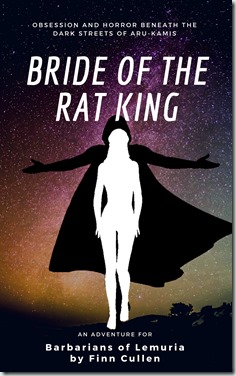
Bride of the Rat King–an adventure for Barbarians of Lemuria

Bride of the rat kingMy new adventure for Barbarians of Lemuria – Mythic Edition is now available free.

Your bold heroes are engaged to investigate the disappearance of a young noblewoman in the shadowy underworld of the city of the Lich King.   Dangers, death, intrigue and some foul magic will surely await – as you would expect.

The folder includes the pdf of the adventure itself plus some .png files ready made and scaled for use as Roll20 battlemaps (the file name gives the size of Roll20 screen to create for an exact fit)

I’ve included some conversion notes for Index Card Role Playing Game the philosophy and mechanics of which have been inspiring me for a while now.

I hope you enjoy the adventure – please let me know what you think and how things go if you bring it to your table.

Edited to remove outdated link:  Now available free (or pay what you want HERE)