Gaming

Campaign Tarot – #TrailOfCthulhu

I’m quite pleased with the latest iteration of my Roll20 “home screen” – this time for a Trail of Cthulhu campaign.    Rather than repeating my Incident Board idea from my Night’s Black Agent’s Campaign I’ve gone more for a classic desk-top look with cards representing the key locations and characters appearing in the episode.

This one is set up for the end of an adventure in which valiant Boston cops take down “The Boston Devil” a cannibalistic serial killer after gaining advice from (real life) anthropologists Richard Speck and Gladys Tantaquidgeon whose likenesses appear at the top-centre of the layout and who first introduced the investigators to the concept of Wendigo…

Thoughts

At the Mountains of Harrogate – #TrailOfCthulhu

Okay this is not strictly a gaming post but it will I’m sure be of interest to some gamers.   HP Lovecraft’s “At the Mountains of Madness” has been turned into a play and I went to see it last night at the Studio Theatre in Harrogate.

It was the last performance in Harrogate but I know it’s also been performed in other venues and will continue to be:  The production company’s website is Here

The play is a one-actor piece, with Royal Shakespeare Company actor and RADA lecturer Tim Hardy delivering a bravura and strung out performance as a desperate William Dyer pleading with his fellow scientists not to repeat his mistake and carry out an exploration of the heart of Antarctica.  He reluctantly recounts the tale, aided by radio-broadcast flashbacks of the voices of the other members of his team and incredible lighting and audio effects.

The piece was dramatic, compelling and very true to the original tale and I really recommend that anyone who gets a chance to see it does so.   There was also a Q&A session afterwards which was fun and it dawned on me how many of Lovecraft’s tales would suit this format – the tale of a single survivor recounting the horrors they have encountered.

Here’s the trailer.   And by visiting the Icarus Theatre site linked above you can support the company and get a CD of the entire performance.  

Gaming

Commonplace Cullen – #TrailOfCthulhu #FearItself #Esoterrorists

A friend of mine shared the following humorous graphic on Liber Faciem recently:

And there is more than a modicum of truth to it. I’ve recently taken to jotting down simple ideas as they occur to me using the web tool Trello as a scratchpad (though anything would work of course) because I know full well that if I wait till I actually have some time to myself the ideas will all have run together like coloured plasticine and their bright hues lost in the murky brown average of “Uhhhh what now…”

My list was originally going to be a list of potential story seeds for my Trail of Cthulhu campaign but having taken the time to review them I think that some may be more suited to one-shots of a Fear Itself nature or possibly (in one particular case) an Esoterrorists investigation.

I’ll probably get round to fleshing out one or more of these at some point and figured that if I post them here it will provide a spur in my side to actually get on and do it, and there’s also a chance that some other GM/Keeper/Asylum Attendant may be able to take one or more and run with any kernel of inspiration they can winnow out of them.    Given the nature of story it’s likely that there may be recognisable elements from other stories, any such resemblance is coincidental and unintentional on my part.   I’ve never been one for buying published adventures so if it turns out that one or more of these is “OMG that’s just 1987’s CULT OF THE RECIPROCATING EEL!” then I apologise in advance.

The Kernels

MORGELLONS – Fibres growing out of the skin. From what? Others see it as delusion. Only very advanced cases show visible evidence to others.  Science treats it as a neurotic delusion – are they covering up the truth?  Perhaps dual reality.  A body horror version of Hildred Castaigne’s crown.

MISSING FOOTAGE – images shot during controversial horror movie supposedly contain something far worse than the film itself. Who has it and what does it show? Death of the infamous director in a suicide triggers the investigation.  Director to combine elements of Browning and Whale though Whale’s suicide was much later.  Who redacted the film and why?  Is the missing scene still being shown to specially chosen audiences?

RAILWAY CARRIAGE – empty when it emerges from a tunnel.  Obvious assumption some sort of dimensional abduction… perhaps twist it around.  Other passengers and crew are cultists committing “simple” act of ritual murder disguised as vanishing (Esoterrorists counting on “vanishing carriage” myth spreading?).   Anomalies in timetable may reveal a missing hour when the crime took place.   Duplicate carriage swapped out to minimise time gap & forensic traces?

SCHOOL – A remote boarding school for the children of the privileged falls prey to malevolent stalking forces that begins to feed upon the staff and older children. The younger kids are untouched… and possibly to blame?  If adolescents engender poltergeists maybe pre-adolescents open the door to something worse, hungry and jealous.

FINAL DREAMS – the distorted dreams of an dying man in the grip of dementia take on bizarre and terrible life in the world around him.   In his youth he witnessed something dreadful and that ancient atrocity starts to colour the present.   

STONE VOICES – a meteorite in a museum display reacts to changes in the stars. It begins to change and affect the people around it as it yearns for home.  If it cannot contrive a way to return home (and how could it, it’s a rock) then perhaps it will draw home to it.

SOUVENIR – A man returns home from England with a social illness that proves far worse than expected. The touch of Y’Golonac contaminates with its fetid touch wherever the victim goes.

ENDLESS – An immortal is in a cycle of living, faking his own death, returning to claim his legacy.  Something goes wrong and his legacy is sold on to a third party.   The immortal wants it back quickly because time is running out… he has been keeping something under control all these years and now his control is slipping.

AFTER ACTION – Office staff working for the FBI deal with the aftermath of a raid that ended strangely.   The reports are heavily redacted and point to strange cultic violence.   The field team are traumatised.   Something was unearthed there that continues to affect everyone concerned.   The PCs are the backroom  team and the effects manifest through the accounts of the field team and through the footage they compiled.

THE EQUATION – A student of mathematics vanishes.   The trail leads to odd places and to a reclusive savant that set him onto an obscure set of mathematical problems that unlocked a new paradigm.   They centred round some strange symbols that made sense in the context of the equations he was working with.   Texts and voicemails from the missing man come in, each more cryptic and desperate than the last.   It soon becomes dreadfully apparent that he no longer exists in the mundane world and communicates only by electronic traces, having lost all sense of self.   Worse the same fate will befall anyone who has witnessed those symbols.

PATIENT 23 – Closure of asylum, redistribution of patients – One patient an unidentified John Doe – ten years incarceration – violent & incoherent.  New doctor dealing with John Doe including sedation & hypnotherapy – the patient becomes thoughtful in his quieter periods, brooding.  She has brought back some reason to him.  New doctor kills herself – this brings PCs into the story – She realised the truth and could not bear to live with it.  Scalpel to the throat.  Case files suggest incoherent rambling speech from patient – incomprehensible syllables and odd imagery – starts to infect PC’s dreams – bleak vistas with distant odd spires. Information requested by doctor arrives – identified the patient as someone declared dead a month before admission.  Lead to the man’s past and cultic connections.
The doctor who killed herself shows up again, lacking all higher reason, breaks out the John Doe- she is now as undead as he.  And they wish to spread the gift.

PORTMANTEAU – The entity manifests through its worshippers and its area of influence, but never entirely through one single victim.   An eye may form on the body of one of them, a mouth on another, a grasping tendril on yet another and so on.   If the victims meet they may meld together in some way to begin reuniting the jigsaw entity.   The mouths whisper disconcertingly and work to instruct their host in foul magic designed to spread the contagion further.   The eyes drive their hosts to witness dreadful things and send them to the scenes of accidents or disasters or to view the endless night sky for hours on end.   The tendrils pierce and draw nourishment from lesser creatures and can infect a victim with another aspect of the creature.   The worst are the ulcers that ooze a corrosive slime that while it does not affect the host will corrode and degrade their surroundings.
“The bringer of peace” = misunderstood “he arrives in pieces”


IN PEACE – Characters wake up with little memory in some out of the way place.   They discover their healed wounds.  They realise they are dead.  Who killed them and why did they come back?   Can they live again or is their happy ending simply a natural death?  What do they need to do to stay animated…

GATE – Characters investigate mysterious events involving a disappearance.   Their route leads them to a mysterious symbol that is a gate.   They find themselves somewhere strange and gradually discover they are aboard an infested space station in the far future light years from earth (or possibly above a deserted earth that has fallen to horrors)
There’s my brain-dump so far.  If anyone feels like they want to expand on anything here I’d be fascinated to know how you’d take it.

Gaming

HP Lovecraft and the Opera Ghost #TrailOfCthulhu

I came across something today that puzzled me at first and then intrigued me.

I found this essay online – “The Horror on the Wall” by ST Joshi about Lovecraft’s opinion of movies, and in it was a passage about a favourite of mine which I am glad to hear that Lovecraft also rated highly – the Phantom of the Opera, starring Lon Chaney (in my opinion one of the finest actors who has ever brought his art to the screen.  That is only my opinion but you are entitled to disagree and that’s fine as long as you don’t mind your opinion being held in justified contempt by right thinking folks).

Lovecraft saw Phantom in 1925 and wrote this:

 “. . . what a spectacle it was!! It was about a *presence* haunting the great Paris opera house . . . but developed so slowly that I actually fell asleep several times during the first part. Then the second part began–horror lifted its grisly visage–& I could not have been made drowsy by all the opiates under heaven! Ugh!!! The face that was revealed when the mask was pulled off “

Well quite. Chaney’s self devised make-up was a wonderful piece of grotesquerie, replicating so near as could be achieved the death’s head look of the novel’s Phantom rather than the mild sunburn of the latest cinematic abomination to take the name.

But what intrigued me most were the next words in Lovecraft’s letter (emphasis mine):

“The face that was revealed when the mask was pulled off . . . & the nameless legion of things that cloudily appeared beside & behind the owner of that face when the mob chased him into the river at the last!”

As you young people say, “Wait, what?”    Nameless legion of things that cloudily appeared…   I don’t recall any cloudy appearance of things, nameless or otherwise.

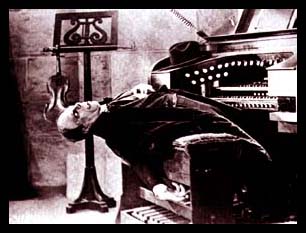
Now the ending of Chaney’s Phantom is not ideal.   The novel and the originally shot ending of the 1925 movie both ended on a note of poignant drama as the psychotic Phantom releases the object of his fixation to live a normal life with her beloved Raoul, and then himself perishes alone of misery and a broken heart.   The originally shot ending of the movie truncated this to happen in minutes rather than weeks but nonetheless ended with a mob breaking into Erik the Phantom’s lair and finding him dead at his organ.

A surviving still of the original ending, now alas lost

That was shown to test audiences comprised, like most movie test audiences, of movie goers who naturally eschewed such moments of drama and poignant character resolution and demanded some active justice so Carl Laemmle had the sequence reshot as a carriage chase involving an angry mob pursuing Erik through Paris, beating him to death and throwing him in the Seine.   There would presumably have been a custard pie fight too, as crowds love those, but I guess the custard wasn’t delivered in time.

Anyway, those are the two endings I know of for the 1925 Phantom.  Lovecraft of course saw the ending from the final cut of the movie in which Erik is chased, battered and thrown in the river.  But I haven’t seen a single nameless legion of things cloudily appearing in that sequence.  Unless you count Parisians of course, but to be honest I think Lovecraft rightly included them in the word ‘mob’.

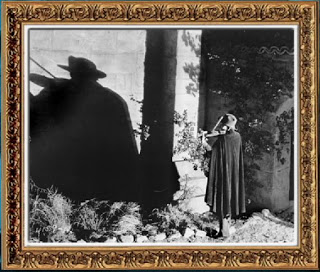
Erik serenades Christine at the cemetery where her father’s body lies
– a scene cut from the final version

The film had a troubled history.  The director Rupert Julian didn’t seem to have a cohesive vision for the work and lots of the scenes veer wildly between the macabre, the comical and the just plain baffling.   The character of The Persian, an unnamed figure from Erik’s past appears as he does in the novel but is suddenly renamed Inspector Ledoux of the Surete for no good reason and doesn’t bother to change out of his fez.   The ghostly rat-catcher of the novel appears and is entirely unexplained, and so on.   Scenes were filmed, used, recut, moved, dropped and reintroduced throughout the production.   In 1929 the whole thing was recut and scenes were added and dropped to conform to a new vision of the whole, including scenes shot from alternate angles during the original filming.   Most cuts of the movie you can see these days are drawn from the 1929 version as the original negatives of the 1925 version are in poor condition.

This video clip compares and contrasts the key unmasking scene from the 1925 and 1929 versions to illustrate the differences that exist.

Returning to the question in hand then, did Lovecraft, in 1925, see something we don’t have in today’s version of the film?  Did he simply imagine them, dredging up eldritch additions from his imaginative depths?
Were there actually nameless legions of shadowy things that appeared to witness Erik’s demise?  Certainly no such things appear in the novel as there is no equivalent scene in the novel.    Was there a cut, that Lovecraft saw, in which things appeared there on screen at such a key moment?  If so what were those things and why were they so ruthlessly expunged from all further cuts of the movie?

And if surviving film of that original sequence with Lovecraft-witnessed nameless shadowy Things still exists what would happen if it was found and viewed?

That’s one I’ll mull over for a while but I thought I would throw open that question to any Keepers out there who may want to revisit with Lovecraft’s eyes this cinematic conundrum.

What new surprises lie in store?

Gaming

Found Carcosa #TrailOfCthulhu

I’ve been plundering the themes and flavours of Chambers’ work recently but today for the first time I came across this little gem.
The Carcosa mansion, built in 1896 to 1897 was intended as the residence of the British High Commissioner in Malaya.  It’s now a luxury hotel though given the antecedents of the name I suspect that the much vaunted Hotel California would be a safer place to visit.
The name was taken straight out of Chambers’ work as Sir Frank Swettenham, the aforementioned High Commissioner, explained:
To the Editor of “British Malaya”
[British Malaya, May 1936]
SIR,
In the April magazine your correspondent in Malaya asks me, in courteous terms, to tell him why I gave the name “Carcosa” to the house that was designed and built for me at Kuala Lumpur by the late Mr. C.E. Spooner, assisted by Mr. A.B. Hubback – as he was in those days – and I have no objection to answer the question even though the simple truth may spoil a number of excellent stories. When this house was finished and occupied I read a book which interested me. It was called “The King in Yellow” and at the beginning of this book there were some verses with a note explaining that they came from Cassilda’s song in “The King in Yellow”, Act 1, Scene 2. Here are two verses: –
“Strange is the night where black stars rise, And twin moons circle in the skies, But the stranger still is Lost Carcosa.”
“Song of my soul, my voice is dead; Die thou, unsung, as tears unshed Shall dry and die in Lost Carcosa.”
I did not call the Resident General’s dwelling “Government House,” or “King’s House,” because neither seemed an appropriate name in Protected States. I did not give it a Malay name, because it was to be the residence of a British Officer; so I took a book name as has often been done before.
As to the word Carcosa, I imagine it was the Castle of the King in Yellow, but the book explains nothing about either the place or its occupant. That apparently can be found in the play, to which there are only occasional allusions. Probably it is a word created by the author’s fancy, though it looks like a combination of the Italian words cara and casa and would mean “desirable dwelling,” as indeed I found it.
The only curious fact is that this name was prophetic for, as I understand, the house has lost its name and is thus, “Lost Carcosa.” The occupant, I am told, is now styled “F.S,” instead of “R.G.”
Yours obediently,
FRANK SWETTENHAM
19 April 1936.
Oh and the logo of the hotel is a yellow sign.    Clearly a coincidence.

Next question – how long can I resist the urge to send one or more of my groups of player characters to Malaya…
Gaming

The Gate of Amen-Ekot #TrailOfCthulhu

They say (but you know the sort of thing They say) that the much reviled sorcerer of the lower Nile, Amen-Ekot boasted that he could never be truly slain by his many enemies because he had entrusted his vital essence to a safer place than “any vault of all too perishable carrion meat” as he charmingly referred to his own body.

His enemies decided that they’d take the risk and slew him, cutting his perishable carrion meat into exactly forty one pieces, each one of which was burned seperately.

None of them were happy to hear reports of his reappearance less than a month later.

It transpired that the fellow had found a way to paint his likeness, or his symbolic likeness at any rate (since in reality he did not have the head of a blasphemously disfigured ibis) into the hieroglyphs and frescoes of a local shrine.   They beady eye of that foul painting could captivate the viewer and by an act of will (that will being often overborne by the sorcerer’s dread intent) could draw the painted essence of the sorcerer forth again as whole as he was (and bearing the memories up to the point) when the image was created.

They say (but you know the sort of thing They say) that the Gate works both ways as Gates are wont to do and that if he had chosen, Amen-Ekot could instead draw in a hapless viewer whose symbolic image would appear alongside that of the cruel magician and in that strange nether-realm of which the painted frescoes were but a representation, he could interrogate or consume his captive.

It is to be hoped that all the representations of Amen-Ekot were destroyed in the weeks and months after that first dreadful resurrection.   It is to be hoped that his writings were all destroyed and that no remnant exists of the instructions for this damned ritual.

On an unrelated* note I’ve always liked this video from A-Ha, even though the song itself is the usual banal nonsense.

* Not Really.

Gaming

The Saint’s Hair?

Ethelflaeda was a pious woman, so they said.  Devoted to God and to his service.  And in those long ago days before the first millennium had come and emptily gone who was to say that the unorthodox methods of her worship were to be condemned?  They say she used to stand naked in the river in the heart of the night, in the coldest heart of the coldest night, and chant prayers to the Almighty.

She was a strong leader of the sisters under her rule and the abbey in the marshes, at Rum’s Eg, flourished.   And she continued her private devotions in the heart of the night, in the river, in the only garments her God had given her.

History does not record what happened to her after her death, but the Church declared her a saint for her devotions and her leadership.

Eight hundred years later, a blink of the eye to some, a gravedigger named Mr Major was digging in the grounds of the abbey and discovered a coffin whose presence was previously unknown and unmarked.    What happened next is given in his own words (and spellings)

“Wee began the work with the pickax and shovell, witch is the proper tools for excavation. Wee came on a led coffin. I acquainted the Vicar of the discovery. I was to find if thare was any bones in it. If so, it was not to be removed. I tried by making a hole on the top. I thrusted my hand to the head of the coffin to find the scull. I found no bones but a scalp of feamial [female] hair as bright as any living ladies hair I have ever seen. There was 1 finger bone. It became dust immediately the air came to it. This is a Trew History of the hair and the coffin.”

There was no body there, no bones, nor remains except for one finger bone which turned to dust as soon as the air (or sunlight) touched it.   But the occupant’s hair remained, bizarrely (miraculously) preserved.   Traces of the scalp remain.

The scalp and hair are displayed now, a museum curiousity, and while tests have been carried out on the artefact they have revealed only an estimated date of around the first millennium for the person whose hair this was, and traces of pine resin in the hair (not native to the area) and evidence that her diet included fish.

Story Seeds
Ethelflaeda was a real person and I’m not going to slander her memory with bizarre and dark speculations.    However in the spirit of fiction and appropriating writhing grubs of history for cultivation into winged stories here are some ways this strange find at Romsey Abbey may be used in a Trail of Cthulhu setting.

Who was Ethelflaeda worshipping in her extreme and private devotions?   Naked river praying was not orthodox behaviour even in the early Saxon church (I wouldn’t put anything past the more inventive Celts of the period, or any period really) so who was the recipient of her prayers?     The abbey was on the very edge of the marshes too which adds a fetid air to the whole proceedings.   My inclinations would be toward making her a devotee of Shub Niggurath, that writhing goddess of fertile and over-fertile life in all its forms, accepting the priestess as her servant and perhaps the prayers of Ethelflaeda’s sisters, unknowingly offered in the wrong direction.   Fish came to the abbey and the area in abundance, and there were strange oils and resins in the preserved scalp that did not come from local vegetation.     Since no great harm seems to have been done to the area or its people then it is unlikely the goddess herself paid too close attention to the rites being undertaken, or perhaps too little time had passed by the time of Ethelflaeda’s death for Shub Niggurath to stir herself and take notice.

But there were effects of course and as we know the the life force of the devotees of the unknowable gods hastes not from their charnel clay and in this case though the body itself decayed and departed without leaving a trace that mysteriously preserved grisly scalp still seethes with the earthbound soul of the priestess.     If it were to be taken from its museum case, what then?

Suppose a student of ancient lore looked deeply into the history of the area and saw past the official church interpretation of the matters.    The Romans had put down barbaric revels in the area around Rum’s Eg long before the Saxons had come.    They had smashed votive stones and put worshippers to the sword in a way that the usually pragmatic legions avoided.   After the Romans withdrew the old ways resurfaced for a short time, old songs were song in the dank marshlands and when the strange lights moved on the damp trackways all other folk kept far away from them.   No wonder King Edgar wanted to build an abbey there, a counterpoint to the horrors beyond the fringe of civilisation.    But the old songs keep on being heard and voices answer.     The scholar of such things would read of Ethelflaeda’s devotions and begin to wonder… and they would find the scalp so lovingly and reverently displayed,,, and they would wonder about that too.

It would be a matter of a few moments of daring to break the glass and take the rank thing, to squirrel it away in answer to a growing obsession or need.   And then that scholar would brood over it and keep on wondering.,, his dreams filled with images of burgeoning plant life and luxuriant rich vegetation.   Plants can be grafted onto living stems…     He would begin to hear the old songs raised at night time, in his dreams, in the voice of a woman calling across the centuries.   Plants can be grafted onto living stems…

Stealing a living stem would be harder than stealing the hair and scalp ever was.  A  living stem would struggle and scream as it was prepared, as the living… sap… flowed from the newly cleared graft site.

Oh but if the graft was to take.   What glorious new growth might there be?

Carved Corbel at Romsey Abbey depicting a female figure giving birth

Gaming

Earworms of Y’Golonac

This is an adventure outline I worked up for a Trail of Cthulhu one-shot that I had planned, set in modern day Leeds.

Y’golonac – by Finn

It’s not fully polished and lacks game related statistics etc, and is a brief framework for an adventure that I think would suit the Purist rather than Pulp mode of play.    Keepers can of course change the location and details to suit their campaign, and with a little bit of finagling can make it suitable for multiple investigators rather than the single character I had created it for (one of my regular sessions is me and a single player).

It’s quite open ended after the first set-up scene which exists basically to show the investigator someone who had gone a long way down a particularly dark path… and then to set their own feet on that same path.    There are hints in there of investigative avenues that Keepers can flesh out as they wish and a variety of sketched out NPCs that can become allies, adversaries or some combination of the two as things go on.

While suggestions are given for potential end points and solutions nothing is set in stone.   My own style would be to run this and see what paths the player’s choices led them down and adapt accordingly.

I hope it is of interest and whether it is of use in its current format or not I hope it may perhaps spark an idea or two that you can use.

Download PDF