Gaming

Party Time #fatecore

Yesterday’s session of the Sundered Seven fantasy campaign took place entirely within one room (with a short side trip to a wine cellar), lacked combat, treasure or magic and was still one of the most intense sessions of any roleplaying game I’ve played.

Our heroes Lord Adriel and his faithful servant Inye had arrived in Hrafburg, capital city of Malmor, to seek an audience with the ruler of the city.  He had reacted in his usual arrogant way (the man has royal pretensions) and told them he would send for them when ready and so Adriel was forced to kill time in the city until then.

We opened at the lavish party being held by Lord Hazreth a newly arrived nobleman who enjoyed offering hospitality.    All the haute monde were there and there was an atmosphere of casual decadence.   Adriel was enjoying the company of two of the eligible ladies of the court (one of whom turned out to be the ruler’s mistress… so that wasn’t a source of tension… really)

But things really cranked up when I introduced the young lord Teltandin, a contemporary of Adriel.  He hadn’t featured in the campaign before but I had him earmarked as a rival for Adriel so I threw the details over to the players with a couple of questions:

What did Teltandin do to humiliate Adriel when they were children?
What did Adriel do to Teltandin when they were young men?

We learned that Teltandin had been sparring with Adriel when they were about eight years old… and though it was a “friendly” bout organised by their parents – rulers of rival houses – Teltandin took it very seriously and used some dirty tricks to win.  Adriel’s father shook his head and walked away in disappointment (a nice trigger of Adriel’s current need to win his father’s approval).

In return a few years later Adriel deliberately spooked Teltandin’s horse causing it to bolt and humiliate the young man in front of his friends and family.

That set the next scene up nicely as the two rival lords and the two ladies decided to play a harmless game of Hopestones for pennies.   For pennies, sure.   No high stakes.

Things escalated of course and it ended up as a duel of gambling between the two men with a lot riding on it.   Social skills were unleased to gain advantages for upcoming rolls, psychological games were being played by everyone at the table.   Faithful Inye saw Teltandin palm a high value tile for future use and managed to tip his employer off.     That was dealt with by Adriel tipping some tiles accidentally onto the floor between rounds and saying “we’d better count them to make sure none are lost”… forcing Teltandin to sneak back the palmed tile.

The final round played out as an extended contest and Adriel won resoundingly winning the approval of the onlookers and earning more hatred from Teltandin.   It was an intense scene with never a blade drawn.

Meanwhile Inye had been using his servant’s inconsequentiality and observation skills to move among the partygoers trying to learn what he could.   I’d set a value for the scene as a whole to have a “Discretion 1” rating – people were drunk and their guards were down so Inye could overhear conversations.    I had him make a Notice roll which he succeeded at very well and so I took inspiration from Dungeon World and said for every point he succeeded by he could ask me one question about the city and its rulers that I would answer honestly.    As a mechanic that worked really well and allowed me to convey the information that was important to the players without some contrived info-dump.    As a result Inye learned of the two rival factions at court (the Count’s wife favouring a diplomatic conquest of nearby lands, and his son leading a more military faction), what the Count’s priorities are (he really really wants to be King) and some of the major players.

We all enjoyed the experience a great deal – and Fate lends itself well to making up mechanics on the fly.   The gambling “rules” were freeform allowing an intense round by round duel of wits and influence that simply comparing rolls would not have allowed, and the way we resolved Inye’s information gathering was elegant and will certainly be used again.
Gaming

The Sundered Seven

In recent posts I’ve discussed the collaborative worldbuilding undertaken by myself and a couple of players new to Tabletop gaming and posted the questions I set them to outline the basics of the world, and the answers they came up with.

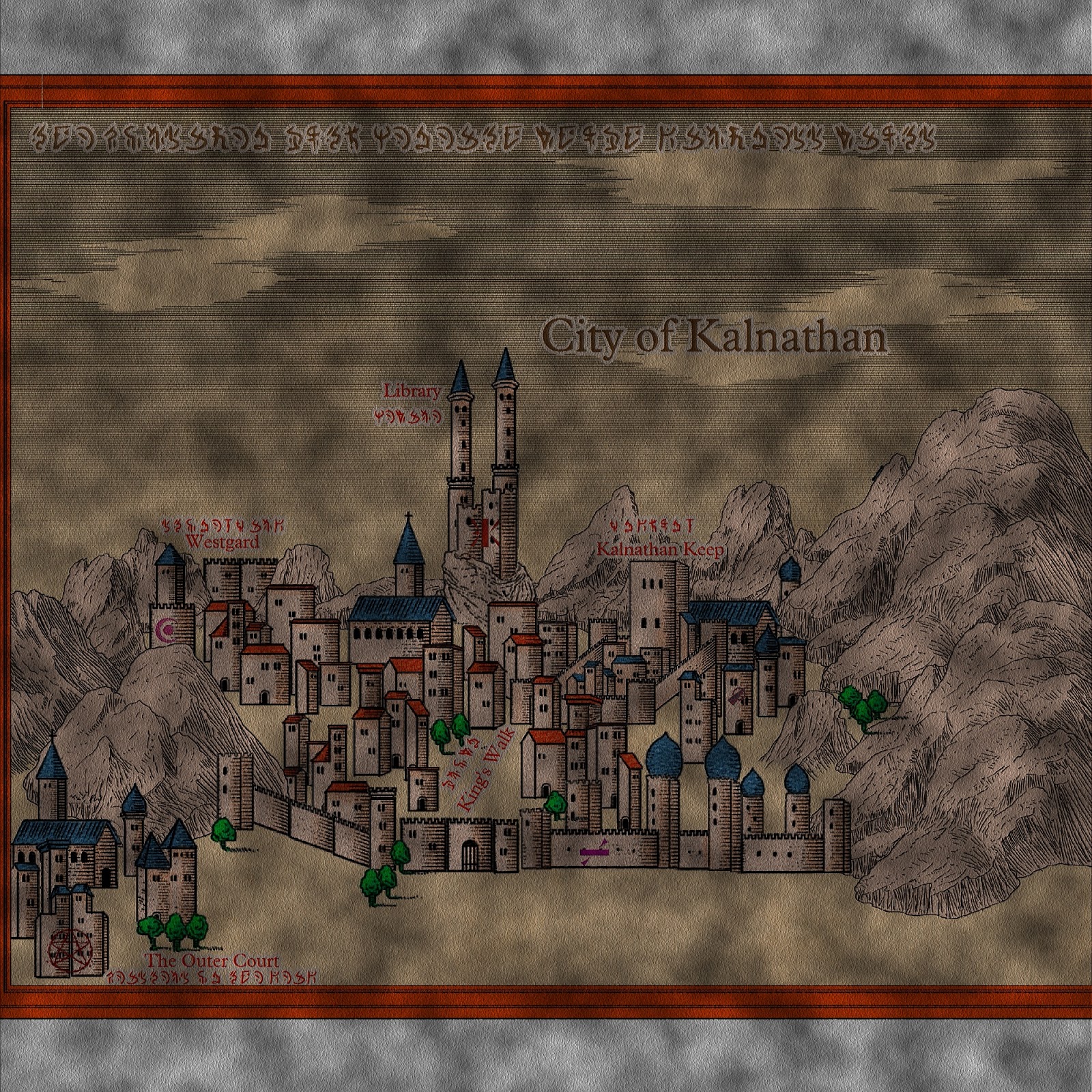
I’m attaching a link to the basic setting notes that resulted and hope they’re an enjoyable read- we’re adding more details as they come out in play of course so this was very much the first wide glance at the setting.   Every adventure has added more information of course as is inevitable, and now we know, for instance, why the abandoned city of Kalnathan is a haunt of ghouls and why the ageless librarians in the tower of that foul city do not venture into the windowless Westernmost tower of the library despite the wisdom that remains on those unlit shelves, and why books of magical lore disguised as collections of erotic poetry are so keenly sought by certain Orloi ladies.

Download PDF

Gaming

Outsourced Worldbuilding – Part Two

 Yesterday I posted some open-ended questions I gave to my two players for a new Fantasy Fate Core game, the purpose of the questions being to allow them to shape the world we’d be playing in.    They discussed things between them and sent back their answers as follows:

Image by Asafesh

How many years is it since the great capital city was abandoned?
120 years 

WHat led to the fall of the royal house.
War 

What price do magicians have to pay for their magic?
Their eyesight 

How many of the noble houses of the realm fell into dark ways?   How did the others respond?
About 40%, the others are resisting more or less openly depending on their level of bravery. 

Why are priests shunned by wise folk?
Priests are not looked kindly upon by the powers that be, and so people don’t want to associate with them and risk getting entangled. 

Which of the gods is still revered by the common folk and why?
A warm deity, often associated with harvest, mercy and peace 

Why is it hard to reach the elvish lands?
There is a large mountain range to cross to get there. 

What weapon is the weapon of the nobility?
Naginata-type of weapon  

What non-combat skill is a true nobleman or woman supposed to master?
They’re supposed to have some kind of musical skill – whether that’s singing or an instrument is not important (Though preferably both). 

What do people swear by when they really mean it.
By my mind, heart and hands (ordered by order of operation) 

Have the trolls gone for good or might they return some day?  Who or what defeated them last time?
They might be back. The royal family and their loyal supporters did.

That gave me a good starting point for defining the world –

Since the fall of the capital city and the royal house was as a result of war just over a century ago, I figured the land would still be pretty fragmented.    Having just under half of the noble houses turned to the dark ways suggests that they were the ones who opposed the royal house and the status quo while the other noble houses were the loyalists… and therefore the losers.    And since that was only a century or so ago there would still be a lot of bad blood between the big families.

The questions about customs, the nobles wielding a particular type of weapon and being expected to be skilled at music suggests some nice background colour for the setting, and I really liked the idea of magic use costing the practitioners their eyesight.  That makes magical ability something with a real cost, and also allows for some nice distinctive NPC magicians who have to find ways to compensate for what they have given up.

The players had a good enough time with coming up with the ideas that I followed up with a second round of questions to dig a little deeper and flesh things out.   The questions and their answers are here:

What obligations are placed on members of the nobility that do not apply to the common folk?
Every noble family that has 3 kids or more must send one of them to join the army.
(Player commented: One of us might be escaping that)

What is the Final Oath?  That’s the oath the last king swore before the last battle, swearing to protect his people. 

Why does the last king’s spirit still haunt the ruined city?  He hasn’t fulfilled that oath.  

What is/was Duke Raendor’s secret? He’s secretly protecting a descendent of the royal family.  

It was lost at sea and the people of the coast rejoiced – what was it?  A slave-trader ship + crew that had been raiding the coast.  

What was the greatest creation of the dwarves and who stole it? A mechanical contraption with numerous uses, some of which are rather obscure. It was stolen by a small sneaky quiet thief, usually called The Weasel. It’s not entirely certain if it was his own idea however.  

What animal do they liken the king of thieves to?  How secure is his hold?  He’s likened to a snake, and his hold is pretty secure.  

They call her the Lady of Sanctuary – who is she and what does the title mean?  She is the goddess of harvest, mercy and peace. Her title alludes to the fact that she gives refuge and healing to suffering souls after death.  

Which group of people wears the tattoo on the back of their right hand? Slaves do

Plot hooks galore.   The players pretty much decided that one of them would be playing the third child of a noble house who was skipping out on their military service,    We have the ghost of a king haunting his abandoned city because his spirit cannot rest because of an unfulfilled oath.   We have a nobleman hiding an unknown scion of the royal house.   We learned that there is a predatory slave trade assailing the country, that there is a master thief called the Weasel who – on the orders of some mysterious other – has stolen a dwarvish artifact, and we’ve fleshed out the only deity still actively worshipped in the area.   Given how much conflict and discord there is in the kingdom I can imagine why a goddess of mercy and peace would still have followers.

We all really enjoyed the process and it gave me as GM an awful lot of material to work with when I sat down to flesh out the details – which I may post at some later time.   One thing I really appreciated about the process was the knowledge that if I presented the same questions to another group, or even to the same group again at another time, we’d end up with a world with plenty of background and potential plots that wouldn’t need to resemble this one at all.

I followed the worldbuilding questions up with some more character focussed ones once the players had their core concepts for their characters worked out, and in much the same vain they were open ended leading questions designed to bring out key points of their past and a cast of associated characters that could act as friends, rivals or just background colour.     It’s the first time I’ve used this process but the results have been very satisfying and I’ll almost certainly use variants of this in the future.

Gaming

Outsourced Worldbuilding

One of the things I loved the most about Fate Core when I first picked it up was the emphasis on collaborative world-building – the creation of Aspects for the setting and attaching Faces and Places that the players come up with in concert with the GM.

Image by Jessie Therrien

I do most of my roleplaying online these days using Roll20, Hangouts and/or Skype and two of my players were interested in starting up a Fantasy campaign using Fate.   While they’re both seasoned veterans of PlayByPost and even some magnificent LARPS with casts of hundreds and spanning years in the forests of Europe they’ve never done Tabletop before.   I figured that sitting them down and trying to explain Aspects and some of the rulesey stuff about Fate (even the approachable Fate) might not be the best way to start, but I did want to involve them in the creation process so I hit upon a compromise idea that turned out to pay dividends.

I created a questionnaire for them with a few leading questions in there – not leading in the sense that I had particular outcomes in mind, but in the sense that they opened the door to a variety of tropes – and then I left it with them both to discuss between them.

It worked well, and I can recommend it as a great way to get the creativity going in a group even before sitting down together to play, with the beautiful bonus that everyone is invested in the results and knows the setting much better than if they’d simply been presented with a sheaf of pages of background material from the GM.

The questions are reproduced here.  In the next post I’ll share some of the answers they came up with which formed the basis of the world we’re now playing in.

How many years is it since the great capital city was abandoned?
What led to the fall of the royal house?
What price do magicians have to pay for their magic?
How many of the noble houses of the realm fell into dark ways?   How did the others respond?
Why are priests shunned by wise folk?
Which of the gods is still revered by the common folk and why?
Why is it hard to reach the elvish lands?
What weapon is the weapon of the nobility?
What non-combat skill is a true nobleman or woman supposed to master?
What do people swear by when they really mean it?
Have the trolls gone for good or might they return some day?  Who or what defeated them last time?