The spirit of the staircase started haunting Graham Tavistock before he reached the bottom of the narrow stairs. He paused next to the noticeboard where the menus of a dozen local takeaways were pinned and wrestled with his conflicted feelings. The spirit in question was not some supernatural entity but the experience named by the French and common to humanity of thinking of the perfect response, put-down or counter-argument just too late for it to be useful. The idea was that such things came to you on the staircase on your way out. Tavistock knew the phrase and wasn’t amused to realise he’d been haunted by such a poorly-timed spirit. He looked over his shoulder up the stairwell, hoping but not expecting to see Lyn hurrying down to tell him she’d reconsidered and he was right about everything and things could carry on exactly as they had been. When that unlikely hope proved forlorn he considered his fallback plans. He could march defiantly back up the stairs and tell Lyn and that smug bastard she was drinking wine with exactly why her reasoning made no sense and that all she had demonstrated, once again, was her lack of impulse control and her inability to see beyond her needs of the moment. He could, but he wouldn’t, despite the spirit of the staircase having whispered a particularly potent phrase to that effect into his ear. When all was said and done he did not want the night to become any more fraught than it was. And there was always the chance that Lyn would reconsider and things would go back to how they were before if he didn’t make things worse. The final option he considered as he glared up the first turn of the stairway with its dusty patterned carpet, was to go back up there and apologise for whatever it was she’d decided he’d done this time. It might, after all, prove to be something real this time that he could actually put right.
He did none of these things of course. The end had been coming for a while and he’d told himself after the last similar scene that he wouldn’t allow himself to spend his time just waiting for the next crisis or blow-up while fretting about how to delay it as long as possible with a series of placatory offerings at the altar of Lyn’s brittle tyranny.
He let himself out and the cold night air hit him. Graham closed the door feeling the latch click and he wondered if this would be the last time he would go through that door. For all his injured and offended self-talk about her, which he recognised himself was an emotional flinch, Lyn was wonderful in so many ways, and he wondered if he could get used to world in which he wasn’t in her orbit. They’d known each other since university and those first few months of getting to know each other were the best times he could remember. They shared a passion for creative thought and expression, and a sense of humour that allowed each to make every shared experience feel like they were sharing a private joke. There had been nights of wild exploratory passion, tragic emotional depth, warm complacent dreaming times about a future that now seemed increasingly…no… totally unlikely and a joint unspoken understanding that this was it. The real thing.
And they had been the real thing, and they had been soulmates, and they have annoyed each other and they had fallen out, and they loved each other and resented each other and, and and. Was that reality, he wondered? Just choosing one option to stand in for a complex history? Looking at the intricacies of a life and deciding on a summary that made sense in the moment?
It was late, he realised, far later than he’d thought. The scene in Lyn’s flat had turned into a whole act of the drama and he’d been so caught up in it that he hadn’t realised until the curtain fell exactly how long he’d spent there. Not wearing a watch, he pulled his phone from his pocket and the screen lit up with the motion advising him it was almost three in the morning. No chance of a bus or a taxi, and it was cold, and it was a long way to walk home. He could go back to Lyn’s and she’d let him sleep on the couch. Then he put his head resolutely down against the wind and started walking faster toward the city centre that he’d have to pass through on the way back home. After a minute or two of replaying and rewriting the evening as he walked, he passed under a railway bridge and pressed on past a few closed fast-food places and restaurants, their windows dark but teasing delightful dishes from across the world. Graham hadn’t eaten since lunchtime. To his astonishment he heard raised voices, angry and aggressive in the night silence and he paused and looked up, wary and feeling his heart pound.
In front of the Corn Exchange, a grand looking circular building complete with columns and wide stone steps, containing the sort of quirky little shops that could afford the high rent of that prestigious location, was a group of maybe seven or eight. Graham couldn’t make out any detail except that most of them were men, and all of them were agitated and angry. Two opposing sides he decided, there was very much a facing-off across the battlefield look to them, with jutting chins and squaring of shoulders. He remembered when he was a child and saw his tom-cat Beanzy in a similar state of furious immobility with the malevolent Clyde from three doors down. Young Graham had gone to pick up Beanzy to carry him out of trouble and that sudden intrusion had been the trigger for the explosion of aggression from both cats that hurled them at each other and then left Graham scratched and wailing as Beanzy had turned on the hand that reached out to save him. He didn’t even want this crowd of human tom-cats to notice him, there was too much of the boot, fist and forehead about them all.
There was a narrow opening just to his left, a wall-mounted sign advertising it as Hirst’s Yard, brick lined walls and pedestrian paving offering a welcome route away from the budding confrontation. The printed letters beneath the street name advertising a trio of clubs or cafes or venues of sufficient importance to merit inclusion on the street sign reassured Graham that this was no sleazy back-alley but rather just some short-cut he’d never had to take before. The clubs and cafes were closed of course, and the way was darker than he’d like but there was enough light to navigate by. He was surprised to see an ivy-covered wall just to his right as he made his way inside then grinned at himself as he recognised plastic leaves in a screen, discreetly covering over a pair of trade waste bins. Nice area, he thought, when even the rubbish is tastefully disguised behind a gentrified mask. The next few steps revealed metal steps leading up to fire-escapes, and the painted signs of the businesses whose catchy one-word names he’d seen foreshadowed on the street sign. He saw two men in the gloom just beyond those entranceways. Two men hunch-shouldered in conspiratorial conversation, with the gleaming red eye of a cigarette flaring and dying. The low mutter from the men fell silent and both raised their faces to look at Graham as he approached.
Better be nonchalant, Graham thought, just an average, confident, no-trouble bloke on his way home at three in the morning. Don’t show fear, and why would you, just passing on by two reasonable blokes. To his right were the rear-doors of some business and the red letters on white of a sign saying “This door is alarmed.”
You and me both, Graham thought. He looked steadfastly ahead as he drew level with the two still silent men. He’d often imagined how such a situation would go. Confronted with potentially violent or predatory strangers he knew he’d have to put on a bold front, showing without antagonising them that it was not worth their while to escalate things. A few curt exchanges, showing no fear, and that would be that. Or there’d be a chance, he had imagined, to see a blow coming and block it, striking back with sudden and unexpected ferocity that would startle his attacker and give him a chance to run. Though running would take him back the way he came and to the unpleasantly aggressive group outside the Corn Exchange. He didn’t do any of those things. One of the two men stepped forward and shoved Graham hard in the back as he walked past them, no pre-amble of threating words or alpha-male posturing, just a hard blow that knocked the breath from him and sent him staggering and falling forward. A punch from the second caught him on the back of the head as he fell and he saw white light burst across his vision as he hit the pavement. Then there were boots kicking into his ribs and sides and legs. His daydreams had never anticipated this. He covered his head with his arms as best he could, his body being turned over by the impact and more blows landing, again and again, each one a sickening revelation of his helplessness and weakness. When the blows stopped for more than a few seconds, he curled himself up to protect his softness from more pain and risked opening his eyes. His two assailants were turned away from him now, still within easy kicking distance but distracted from their sport by some new entertainment. He heard them speak harsh and mocking to their new visitor and he saw the man they were squaring up to. He looked like one of the increasingly visible invisible homeless who made caves of doorways around the city; grey haired and unkempt, with a tatty beard and layers of overlapping old clothes. He had a woolly hat, Graham noticed pulled down almost to his brows. He didn’t look scared of the two nocturnal warriors, standing casually, his arms by his sides, his head tilted a little like a golden retriever waiting for the next thought to arrive.
“Do you boys know how they hypnotise chickens?” he said, his voice gravelly and hoarse.
Graham’s assailants met this absurd question with short, barked obscenities and a brief but vivid description of what they would do to him if he didn’t, in their words, fuck off and die in a doorway somewhere.
“It’s easy,” said the stranger, “It’s easy to hypnotise a chicken. You just press its head to the ground and then, right, and then you draw a line in the dirt, straight out from its little beak.” He raised his left hand to one side, index and middle fingers extended, and drew them straight down indicating a straight line vertically in the air. Then he chuckled, a rasping chuckle that made Graham think the words death rattle though he had never heard one in real life. Graham braced himself for the violent response of the two assailants, whether aimed at the stranger or at himself, but none came.
“You better go,” said the old man, peering round one of the two younger men and looking directly at Graham. His features were lined but it was hard to tell his age, he could have been anywhere between an old forty and a young eighty. His right eye was a piercing blue, the iris of the left obscured by a pale cataract. Graham half rolled over and pushed himself painfully to his feet, pain in his ribs and arms and legs and belly. The two men who had attacked him remained motionless, arms limp at their sides, both staring at the same nothing in the air. Graham limped past them warily following the old man who was already walking back the way he had come.
“Thanks,” Graham called after him, but the old man did not look around, just gave a shrug of the shoulders beneath the tatty outer layer of coat. By the time Graham reached the other end of Hirst’s Yard the old man, a fast walker, had already turned right and was shambling across the main road and into a wide street lined with big name shops and restaurants. Graham paused and was about to look back to see if his two assailants were still there, still and inexplicably passive, but some dreadful presentiment caught in his stomach and he knew then that he did not want to see what he would see if he looked back. He leaned against the wall and looked away. On the building opposite him, on a stone ledge above the ground floor entrance to some pub or club, a grotesque statue leered down at him. It depicted a muscular man, like a wrestler, half crouching in an aggressive stance and brandishing a scythe, angel wings emerging from his shoulders. Why a scythe, Graham thought, still fuzzy from the pain, if that’s supposed to be the grim reaper, why isn’t he a skeleton? If that’s Death, he told himself, I don’t want to meet him any time soon.
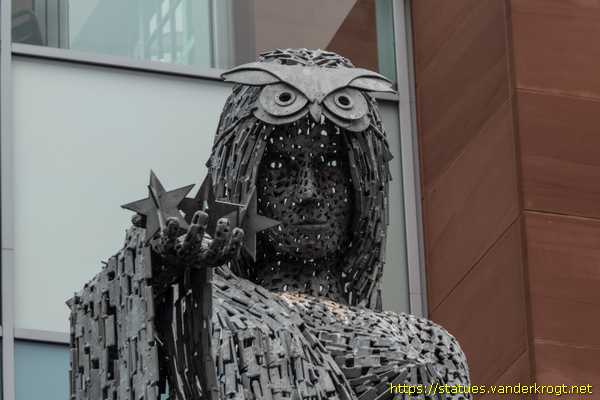
No. That’s not Death. Death has just passed by and you don’t remember. That thought came from nowhere and Graham stepped hurriedly away from the narrow street he had just left. He needed to know what had happened, he needed to understand what had just happened in that strange dark passageway or it would haunt him forever. Breaking into an uneven run, feeling the pain of impacts in his right knee and shin, he ran after the old man. The main road was empty of cars when he reached it and he didn’t slow down before crossing. Over to his right he could still see and hear the crowd of belligerents outside the Corn Exchange, now illuminated by the flashing blue lights of emergency vehicles. Ahead of him slightly to the left of centre of the wide pedestrianised street, he saw the old man. The old man was standing at the feet of a statue on a high plinth, a statue of openwork metal in the form of a woman, robed, the mask of an owl upon her brow. He was talking to the statue, gesturing with his left hand. He laughed that harsh rattling laugh once more, not taking his eyes from the statue’s impassive face until Graham came to a stop just by him. Then the ageless old man stopped his chuckling and turned to Graham, frowning, a question in his expression.
“What happened back there?” Graham gasped, still a little winded. The man shrugged again and screwed up his face.
“Got you out of trouble,” he said, “Got to look out for each other, us outliers. That’s all.”
“I’m not… well thank you. But what did you do?”
Now the old man scowled just a little and his frosted eye seemed to flicker blue and white as a car passed along the main road behind Graham’s back.
“Nothing you want to know,” was his answer, then Graham saw a damp gleam in the shadows of his old face and guessed the man was grinning, showing discoloured teeth. “If you need to think about it remember some horse-shit about hypnotising chickens.”
He winked and clapped a hand on Graham’s shoulder, once, twice, three times before turning back to the statue and bowing his head solemnly.
“But… but that is what happened,” said Graham, “that is what you said.”
The old man was walking away now along the length of the wide street, away from Graham and the Owl-Masked Lady, not looking back. And Graham could not take a step to follow him.
Discover more from Otherworlds
Subscribe to get the latest posts sent to your email.
 Otherworlds
Very intriguing!
LikeLiked by 1 person